Harness boots
Boots by outlet count: 2-way, 3-way, Y and T
Two outlets, three outlets or a Y: GHS2-N-612 passes over 27mm and closes down to 12.4mm.
Three families, and the pair of numbers that picks the size
Three part families carry an outlet count. GHS2-N is the two-outlet boot, catalogued in three sizes. GHS3-N is the three-outlet boot, catalogued in one size, GHS3-N-407. GHYB is the Y type, also one size, GHYB-381-1. Above three outlets nothing is catalogued as a harness boot at all.
Every diameter on these charts arrives as a pair. The a figure is the bore as supplied and it is a minimum. The b figure is the bore after unrestricted recovery and it is a maximum. GHS2-N-612 reads 27 then 12.4 on D1, so it passes over anything up to 27mm and grips anything down to 12.4mm.
A size that clears only one end of that pair will go on and will not seal, and that is the commonest reason an outlet boot gets bought twice. The branch bores in the D2, 3 column behave identically: on GHS2-N-612 they run 13.2 down to 6.1, one figure for each leg.
Length columns L1, L2 and L3 carry ±10%. Wall columns T1 and T2, T3 carry ±20%. Every figure on all three charts below is in millimetres, exactly as the manufacturer publishes them.
GHS2-N and GHS3-N outlet boots
Semi-rigid flame-retarded polyolefin boots that insulate, strain-relieve and environmentally seal the point a cable harness splits into two or three branches. Supplied with or without adhesive lining, standard colour black, manufactured by Gala Thermo Shrink Pvt. Ltd.
- Mechanical protection, strain relief and complete environmental sealing on cable harness assemblies
- Elongation at break ≥500%, and still ≥400% after ageing at 130°C for 168 hours
- Heat shock at 200°C for four hours with no dripping, flowing or cracking
- Solvent resistance after 24 hours at 23°C: gasoline ≥11MPa, diesel oil ≥10MPa, acid and alkali ≥12MPa
| Outlet counts catalogued | Two (GHS2-N) and three (GHS3-N) |
|---|---|
| Sizes | GHS2-N-306, GHS2-N-612, GHS2-N-1218, GHS3-N-407 |
| Largest entry bore | GHS2-N-1218, D1 39mm as supplied to 18mm recovered |
| Smallest entry bore | GHS2-N-306, D1 13.5mm as supplied to 6mm recovered |
| Material | Semi-rigid flame-retarded cross-linked polyolefin, black |
| Lining | With or without adhesive lining |
| Shrink temperature | 120°C, published for the harness boot family |
| Oxygen index | ≥28% |
| Dielectric strength | ≥20 kV/mm |
| Hardness | 90±2 Shore A |
| Low-temperature flexibility | -55°C |
GHS2-N selection chart, two outlets
| Product code | D1 a (min) | D1 b (max) | D2, 3 a (min) | D2, 3 b (max) | L1 ±10% | L2 ±10% | L3 ±10% | T1 ±20% | T2, T3 ±20% |
|---|---|---|---|---|---|---|---|---|---|
| GHS2-N-306 | 13.5 | 6 | 6.6 | 3.3 | 24 | 15.5 | 25 | 2 | 1.5 |
| GHS2-N-612 | 27 | 12.4 | 13.2 | 6.1 | 53.3 | 33 | 55 | 2.5 | 2 |
| GHS2-N-1218 | 39 | 18 | 27 | 12.4 | 79 | 56 | 80 | 3 | 2.5 |
All dimensions in millimetres. Source: the manufacturer's 2-Way Boot datasheet, Issue 1, September 2024.
GHS3-N selection chart, three outlets
| Product code | D1 a (min) | D1 b (max) | D2, 3 a (min) | D2, 3 b (max) | L1 ±10% | L2 ±10% | L3 ±10% | T1 ±20% | T2, T3 ±20% |
|---|---|---|---|---|---|---|---|---|---|
| GHS3-N-407 | 14 | 6.6 | 6.6 | 3.6 | 46 | 31 | 15.7 | 2 | 1.5 |
One catalogued size, not a range. All dimensions in millimetres. Source: the manufacturer's 3-Way Boot datasheet, Issue 1, September 2024.
GHYB selection chart, Y type
| Product code | H a (min) | H b (max) | J a (min) | J b (max) | K a (min) | K b (max) | P b ±10% | R & S b ±10% | W b ±20% |
|---|---|---|---|---|---|---|---|---|---|
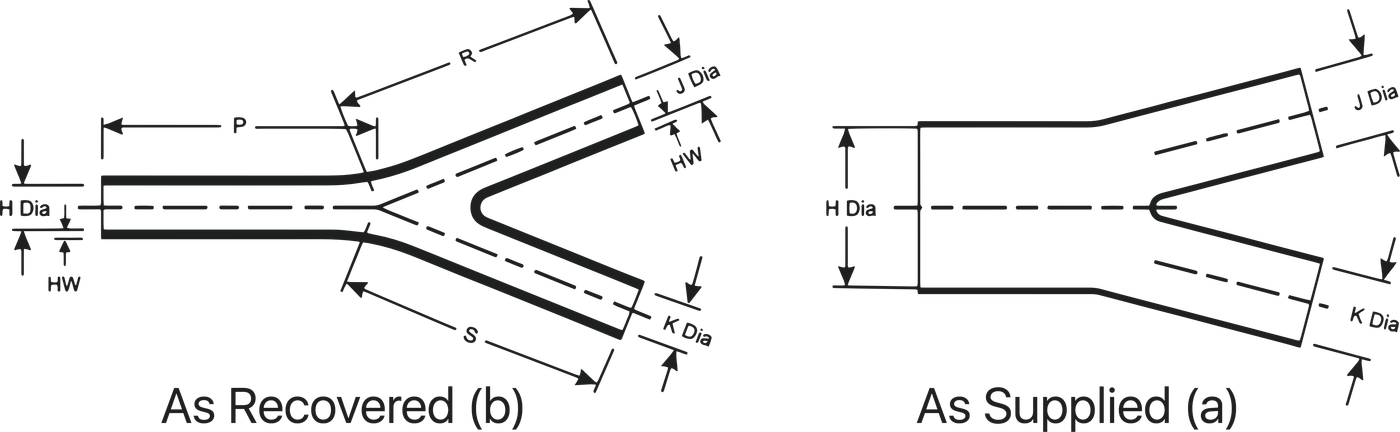
| GHYB-381-1 | 19.80 | 6.60 | 13.20 | 6.60 | 13.20 | 6.60 | 40.60 | 40.60 | 1.50 |
One catalogued size. Different column letters, because the Y type is dimensioned on its own drawing. All dimensions in millimetres. Source: the manufacturer's Y-Type Boot datasheet, Issue 2, August 2024.
Y and T are one request with one catalogued size
An outlet count does not describe a Y. Two branches can leave the entry in line and part late, or leave at an angle and part at the face. The angle decides where the pull lands, and the pull is most of why a boot is there.
That is also why the trade's T and the trade's Y arrive as the same enquiry. Both are one entry and two exits. Only the included angle differs, and no datasheet in the sources this site works from carries a T part code.
GHYB-381-1 is the one Y size published. Its entry takes 19.80mm down to 6.60mm on H, and each exit takes 13.20mm down to 6.60mm on J and K, so the two legs are dimensioned the same. P and R & S are published at ±10%, W at ±20%.
The drawing on the manufacturer's Y-type datasheet fixes where each letter is measured. No legend for those callouts is reconstructed here.
The Y type is qualified against a different property set
The outlet boots and the Y boot sit on one catalogue page and carry two different technical specifications. A drawing that calls up a figure gets a different number depending on which part it lands on.
| Property | GHS2-N and GHS3-N | GHYB Y type |
|---|---|---|
| Dielectric strength | ≥20 kV/mm, IEC 60243 | 10 kV/mm min., ASTM D149 |
| Tensile strength | ≥15MPa, ASTM D2671 | 9.5 N/mm² min., ASTM D412 |
| Elongation | ≥500%, ASTM D2671 | 250% min., ASTM D412 |
| Thermal ageing | 130°C for 168h, elongation still ≥400% | 175°C for 168h, tensile still 8.5 N/mm² min. |
| Heat shock | 200°C for 4h, UL 224 | 250°C for 30 min., ASTM D2671 |
| Low-temperature flexibility | -55°C, ISO 974 | No cracking, ASTM D2671 |
| Oxygen index | ≥28%, ISO 4589 | Not listed; flammability self-extinguishing, ASTM D2671 |
| Volume resistivity | Not listed on this sheet | 1 x 10¹² ohm.cm min., ASTM D257 |
| Water absorption | Not listed on this sheet | 0.5% max., ASTM D570 |
| Fungus resistance | Not listed on this sheet | No growth, ASTM G-21 |
| Military qualification | Material stated as conforming to military specifications; no standard number printed | Type tested to SAE AS81765/1; chemicals, solvents, oils and lubricants to MIL-I-81765A |
What that difference decides
On a vehicle or plant harness the solvent block usually settles it. After 24 hours at 23°C the outlet boots hold ≥11MPa in gasoline, ≥10MPa in diesel oil and ≥12MPa in acid or alkali. Elongation over the same exposure stays at ≥400%, ≥350% and ≥400% respectively. Those figures are on the GHS2-N and GHS3-N sheets, not on the Y sheet, which answers fluids through MIL-I-81765A instead.
The other way round, an airframe or defence harness that has to cite a slash sheet has exactly one part here carrying a type test, and it is the Y. Where the property sets matter more than the size, MIL-I-81765A and SAE AS81765/1 takes them apart line by line.
Neither family is a cable gland and neither carries a gland's mechanical retention. The assembly-side view is on harness boots.
No T part code is published
No datasheet in the sources this site works from prints a T-shape boot code, so nothing here can be quoted as one. Where the branches leave at 90° and the pull is axial on one of them, GHYB-381-1 is still the geometry to quote against. Where it does not fit, the six figures below are what a real answer needs. That question is worth putting to the manufacturer before a drawing calls up a T part number.
The six figures that get a real answer on a Y
Where GHYB-381-1 does not fit, these are the six the Y chart itself dimensions. Sending them beats guessing a size.
- The largest diameter the boot has to pass over on the way on. That is your a figure and it is a minimum.
- The smallest diameter it has to grip once recovered. That is your b figure and it is a maximum.
- The same pair for each branch, taken separately, because J and K are dimensioned separately even where they come out equal.
- Overall length from the entry face to the end of the longest leg.
- The included angle between the branches, photographed against a rule so it is unambiguous in an email.
- The wall clearance available, since W is published at ±20% and 1.50mm can arrive as 1.80mm.
Four outlets and above
Four and five outlets on a power cable is breakout territory rather than boot territory. Insulcore-LV seals the crutch of 2, 3, 4, 5, 6 and 7-core PVC, XLPE, rubber and PILC cable up to 3.3 kV, hot-melt lined and IP68 once installed. The phrase "two-way outlet breakout boot" fuses those two products into one term; breakout or boot pulls them apart in a page, and cable breakouts carries the core-count tables.
Questions this page gets
How many outlets before a boot stops being the answer?
Do I size on 27 or on 12.4?
Is a two-way outlet breakout boot a real part?
Does the Y boot carry the same 20 kV/mm as the two-way?
Is the three-way boot available in more than one size?
I have an old boot off a panel with no marking left. Can I match it from the tables here?
Sizing a two-outlet, three-outlet or Y boot
Where a size on this page fits, the part code is enough to order against. Where it does not, the six figures above are what the manufacturer needs to answer once rather than three times.