One outlet · GHSB and GHRB
Right angle and straight boots
Five catalogued sizes across two geometries. The largest, GHRB-151, goes on over 43.00mm (a) and closes to 26.00mm (b).
Two geometries, five sizes, one table set
Three straight boots and two right angle boots are catalogued in the manufacturer's sheets this site works from: GHSB-111, GHSB-714 and GHSB 202-4, then GHRB-111 and GHRB-151. That is the entire set.
Each chart gives two bores and quotes each of them twice. H is the wide end and J the narrow one. The letter a is the as-supplied minimum and b the fully recovered maximum. A GHSB-111 passes over 25.60mm at H and closes to 10.30mm on free recovery; its J end runs 23.80mm (a) to 4.70mm (b).
The b figure is what the moulding reaches with nothing inside it. A connector and a cable both stop it short of that. So what you are covering has to sit inside the a-to-b span at both ends.
One boot, one outlet. Where cores are separating instead, the part is a breakout — a different decision.
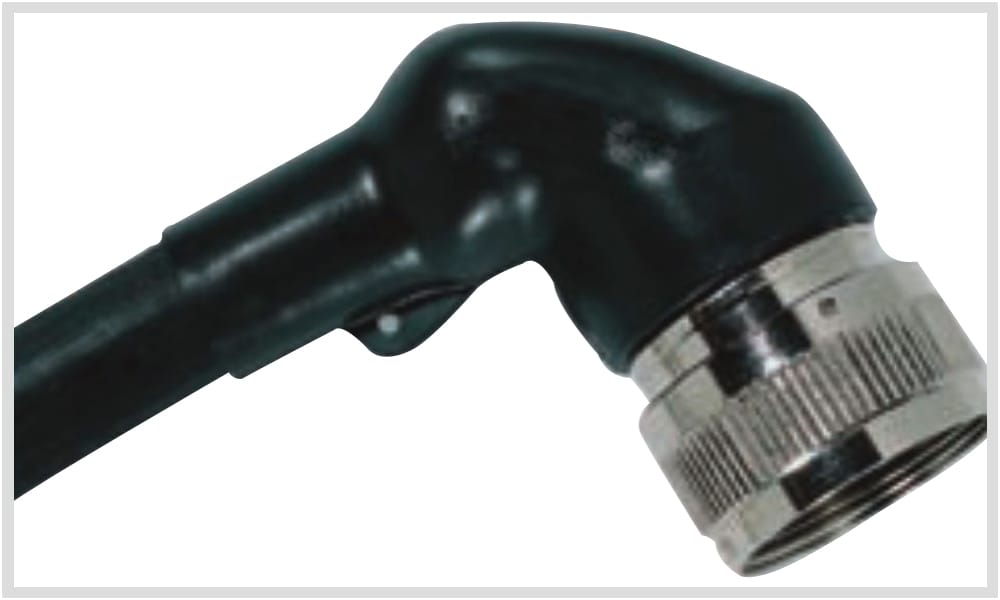
GHSB straight and GHRB right angle harness boots
Cross-linked polyolefin boots that insulate and strain-relieve the point where a connector meets its cable on a harness. Straight and right angle profiles, five catalogued sizes between them, shrinking at 120°C. Manufactured by Gala Thermo Shrink Pvt. Ltd.
- Goes on over a connector already mounted to the cable, so nothing is unmated to fit it
- Chemical, solvent, oil and lubricant resistance rated Good against MIL-I-81765A
- After 175°C for 168 hours the sheets still require 8.5 N/mm² tensile and 200% elongation
- Non-corrosive, so the boot adds nothing to the shell metalwork it closes onto
- Does not melt and resists cold flow
- The Right Angle Type and Straight Type sheets both record type testing to SAE AS81765/1
| Straight sizes | GHSB-111, GHSB-714, GHSB 202-4 |
|---|---|
| Right angle sizes | GHRB-111, GHRB-151 |
| Widest H, as supplied (a) | 43.00 mm — GHRB-151 |
| Tightest J, recovered (b) | 4.70 mm — GHSB-111 |
| Material | Cross-linked polyolefin |
| Shrink temperature | 120°C |
| Dielectric strength | 10 kV/mm minimum |
| Volume resistivity | 1 x 10¹² ohm.cm minimum |
| Tensile strength | 9.5 N/mm² minimum |
| Ultimate elongation | 250% minimum |
| Water absorption | 0.5% maximum |
| Thermal ageing | 175°C for 168 hours |
| Heat shock | 250°C for 30 minutes, no cracking or dripping |
| Low temperature flexibility | No cracking |
| Flammability | Self-extinguishing |
| Fungus resistance | No growth |
Straight boots — GHSB selection chart
| Product code | H a (min) | H b (max) | J a (min) | J b (max) | P b (±10%) | R b (±10%) | U b (±10%) | JO b (±10%) | HW b (±20%) | JW b (±20%) | X b (±20%) | Y b (±20%) |
|---|---|---|---|---|---|---|---|---|---|---|---|---|
| GHSB-111 | 25.60 | 10.30 | 23.80 | 4.70 | 38.00 | 21.20 | 10.00 | 8.30 | 2.00 | 1.20 | 18.00 | 13.00 |
| GHSB-714 | 32.00 | 14.00 | 32.00 | 7.00 | 65.00 | 36.00 | - | 17.00 | 1.80 | 1.80 | - | - |
| GHSB 202-4 | 37.00 | 20.00 | 37.00 | 8.40 | 76.00 | 46.00 | - | 14.50 | 1.70 | 1.30 | - | - |
All dimensions in mm. a is the as-supplied minimum and b the fully recovered maximum; a dash means the sheet publishes no figure for that size. Reproduced from the manufacturer's Heat Shrink Boots — Straight Type sheet.
Right angle boots — GHRB selection chart
| Product code | H a (min) | H b (max) | J a (min) | J b (max) | P b (±10%) | R b (±10%) | JO b (±10%) | HW b (±20%) | JW b (±20%) | X b (±20%) | Y b (±20%) |
|---|---|---|---|---|---|---|---|---|---|---|---|
| GHRB-111 | 25.70 | 10.50 | 22.00 | 4.80 | 24.50 | 25.00 | 8.10 | 2.00 | 1.00 | 16.00 | 14.00 |
| GHRB-151 | 43.00 | 26.00 | 41.00 | 10.00 | 52.00 | 44.00 | 17.50 | 3.00 | 1.00 | 25.00 | 25.00 |
All dimensions in mm. The right angle chart carries no U column at all.
Which columns carry ±10% and which carry ±20%
P, R and JO are ±10% on both charts, and so is U where the straight chart publishes it. HW, JW, X and Y are ±20%. H and J carry no percentage at all — they are an absolute minimum and an absolute maximum.
The ±20% band is the one that catches people out. GHSB-111 publishes X at 18.00mm, so the part that arrives may measure 14.40mm or 21.60mm and still be in specification. That is a 7.20mm spread on a figure drawings routinely treat as fixed.
The same size publishes HW at 2.00mm, which bands to 1.60mm and 2.40mm. Where the gap you are shrinking into is 2mm, most of that band does not fit — and the chart said so before the part was ordered.
Straight or right angle, read off the charts
Neither sheet ranks the two geometries against each other. Between them they publish enough to settle it.
| Read this | Straight — GHSB | Right angle — GHRB |
|---|---|---|
| Catalogued sizes | Three | Two |
| Widest H, a to b | 37.00mm to 20.00mm (GHSB 202-4) | 43.00mm to 26.00mm (GHRB-151) |
| Narrowest J recovered (b) | 4.70mm (GHSB-111) | 4.80mm (GHRB-111) |
| P at the -111 size (b, ±10%) | 38.00mm | 24.50mm |
| R at the -111 size (b, ±10%) | 21.20mm | 25.00mm |
| U column | Published on GHSB-111 at 10.00mm | Absent from the chart |
| X and Y | Published on GHSB-111 only | Published on both sizes |
| Lipped chart | Published, with GHSB 714 marked non-lipped | Published for both sizes |
| Cable leaves | In line with the connector | Turned through 90° |
The retrofit case, and what the 90° exit costs
Both geometries install over a connector already mounted to the cable. Nothing is unmated, nothing is re-terminated, nothing is re-tested. On maintenance work that one line decides the specification more often than any figure in the charts above.
Geometry decides the rest. A straight boot leaves the cable in line with the shell. That suits an axial pull, and it needs depth behind the backshell to take the 38.00mm GHSB-111 puts on P.
Turning the cable at the connector moves that length somewhere else. At the -111 size P falls from 38.00mm to 24.50mm while R rises from 21.20mm to 25.00mm. You are trading 13.50mm on one published length for 3.80mm on the other, and the enclosure decides which of them you can spare.
The letters are dimensioned on the drawing in each sheet, never defined in words. What each letter measures sets them out.
The lipped sheets carry the same codes and four different figures
GHSB-111 J is 23.80mm (a) on the Straight Type sheet and 23.00mm on the Straight Boot — Lipped sheet. GHSB 202-4 J is 37.00mm against 35.00mm across the same pair, and its U column is blank on the plain sheet but 15.00mm on the lipped one. GHRB-151 J is 41.00mm on the Right Angle Type sheet and 40.00mm on the Right Angle Boot — Lipped sheet. Whether the lip genuinely changes the moulding at those four cells, or one chart was retyped, the published data cannot tell you. The safe course is quoting the product code together with the sheet issue and date it was read from. GHSB 714 is asterisked non-lipped on that chart, so the lipped straight range is two sizes and not three.
Bottle, lipped, and the two boots these are not
Bottle boot is the trade's other name for the straight profile, after the wide-to-narrow step the drawing shows. The word appears nowhere on the GHSB sheets. It is a buyer's word rather than a catalogue word, and it means these parts.
Lipped is a catalogue word here: the manufacturer publishes separate lipped sheets for both geometries, each with its own selection chart. What the lip seats against is dimensioned on the drawing and not stated in words, so this site does not paraphrase it. The term is glossed once.
GRB and GSB are a different part. Those are bushing boots for a cable termination box, four sizes in each profile: GRB-1, GRB-2, GRB-2A, GRB-3 and GSB-1, GSB-2, GSB-2A, GSB-3. They are moulded in non-tracking polyolefin and lined with water-resistant red mastic. They shrink at 125°C rather than 120°C, are rated 15 kV/mm minimum against 10 kV/mm, and run continuously from −40°C to +110°C.
One letter separates GRB from GHRB, and ordering across that letter costs a job. The bushing family is covered on insulating boots at busbar and bus-duct terminations; the non-shrink alternative to it is on reusable rubber insulating boots.
“Low profile” — asked for constantly, published nowhere
Low profile straight boots and low profile right angle shapes are searched for in volume against this manufacturer. The phrase appears in none of the 175 datasheets this site works from, and no low-profile dimension table exists in them. In the trade the term means a moulding that stands shallower over the connector than the standard part, for backshell clearance. This site will not build a size chart for a geometry it cannot source. The only honest route is an enquiry carrying your clearance figure and the connector shell size.
Asked about these two
Is GRB the same boot as GHRB?
Does the connector have to come off first?
Is there anything larger than GHRB-151?
What does MIL-I-81765A cover on these sheets?
Will one of these cover a 2-way or 3-way outlet?
Two diameters settle a size question; a part number rarely does
A size enquiry answers in one reply when it carries four things. The outside diameter at the connector. The outside diameter of the cable behind it. The exit angle the enclosure forces, and the clearance available. Sent as a part number off a boot already cut open, it takes four.