Boots and breakouts
How many outlets, and what does it take down to?
Two legs, and the body goes on over 27 mm and closes to 12.4 mm. That is a GHS2-N-612, and those three numbers are the whole specification.
- A breakout seals the crutch — the point inside a multi-core cable where the cores separate.
- A boot seals a transition — where a cable meets a connector, a bushing or a bar.
- Every catalogued size is a pair, never a single figure: a as supplied, b fully recovered.
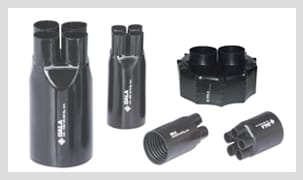
Two parts, two jobs, four words
Most arrivals already hold the part. The split below is geometric, not electrical.
Breakout — inside the cable
The crutch is where a multi-core cable forks. A breakout covers that fork and seals each leg. The low-voltage chart is catalogued for 2, 3, 4, 5, 6 and 7 core PVC, XLPE, rubber and PILC to 3.3 kV. It is hot-melt-adhesive lined and seals to IP68 once recovered.
Boot — where the cable ends
A boot goes where a cable meets something else: a connector on a harness, a bushing in a termination box, a bar in a panel. It is chosen by outlet count and geometry, so a boot chart carries no core column at all.
When the two words collide
The trade uses four words for three parts. GHRB and GRB are different components with different jobs, and a drawing released with the wrong one becomes a re-order. You want the word settled before you open a chart.
a is what it goes over; b is what it closes onto
Every selection chart in this slice prints each diameter twice. The boot sheets head the two columns a and b. The breakout sheets head them Ds and Df. The convention differs; the meaning does not.
a, or Ds, is the as-supplied inside diameter, quoted as a minimum. b, or Df, is the diameter after unrestricted recovery, quoted as a maximum. So a GHS2-N-612 carries a of 27 and b of 12.4 on its body, and 13.2 and 6.1 on each leg. It slides over anything under 27 mm and grips anything above 12.4 mm.
A part is judged against both numbers or it is not judged at all. Sized against a alone, a boot goes on easily and then stands off the cable at a diameter it was never going to close. That is the ordinary reason a correctly ordered part does not seal.
The breakout charts behave identically. LV3GBB-0309 is a three-core size reading Ds 32 and Df 9. Across the whole low-voltage chart the as-supplied figure runs from 22 mm to 370 mm, so a wrong row is rarely a near miss.
By outlet count, then by geometry
The codes are the manufacturer's own. The counts are what the published charts contain, not what can be moulded.
2-way, 3-way, Y and T boots
Harness branch boots. Three catalogued two-way sizes: GHS2-N-306 at 13.5 to 6, GHS2-N-612 at 27 to 12.4, GHS2-N-1218 at 39 to 18. One three-way size, GHS3-N-407. The Y-type is type tested to SAE AS81765/1.
Right angle and straight boots
Single-outlet boots, fitted over a connector already mounted to its cable. Straight: GHSB-111, GHSB-714, GHSB 202-4. Right angle: GHRB-111 and GHRB-151, the larger taking 43 mm down to 26 mm at the H end.
Boots at a busbar or bus-duct termination
Four right-angle sizes and four straight, in non-tracking polyolefin lined with red mastic. They insulate bushings inside a termination box where phase-to-phase and phase-to-earth clearance falls below normal air clearance. Dielectric strength 15 kV/mm minimum.
Reusable insulating boots
A modified silicone/rubber shroud for PILC and XLPE terminations, off and back on as often as the work needs. Maximum system voltage 36 kV for one-minute AC. The connection can be re-energised straight after fitting.
Anti-tracking breakouts
Non-tracking cross-linked polyolefin for the crutch of three-core PVC or PILC to 36 kV. The published figure is no tracking, erosion or flame failure at 3.25 kV held for 20 minutes. Continuous limit −40°C to +110°C.
Semi-conductive breakouts
Belted PILC carries no screen on the individual cores. This family seals the crutch and rebuilds that screen leg by leg, in semi-conductive polyolefin of volume resistivity 1 × 10⁷ ohm.cm minimum. A plain LV breakout here is the classic specification error.
The rest of the site
No guide here repeats a chart that already sits on a product page.
- Boot size chart, and how to read oneGHSB, GHRB and GHS2-N rows, a and b columns side by side
- Breakout size chartDs and Df by core count, two through seven
- Boot, breakout, shroud, sleeve: the wordscrutch, branch-out, free recovery, range-taking, lipped
- Replacing a boot when the part number is gonea measuring method for an unmarked part
- Installing a boot or a breakoutwhere the heat starts, and what incomplete recovery looks like
- MIL-I-81765A and SAE AS81765/1what the military rows on a datasheet certify
- Cold shrink breakoutsGCEB2 and GCEB4 in EPDM, fitted without a torch
- Boots on cable harness assembliesconnector joints, strain relief, 120°C shrink
- Questions we are actually askedthe size and substitution questions that arrive by email
Who writes this, and who makes the parts
Branch Point is published by Gala Thermo Shrink Pvt. Ltd. of Mumbai, established 1979, which manufactures every part named here at Palghar and at Surat SEZ. Every dimension and code on this site is copied from that manufacturer's published datasheets, and where two sheets disagree both figures appear with the sheet each came from. Nothing here carries a price or a stock position.