Cable breakouts, 2 to 7 core
Sixty-nine catalogued sizes: the smallest closes 22 mm down to 8 mm, the largest 370 mm down to 175 mm.
The crutch, and what a breakout does there
A multi-core cable is sealed along its whole length except at one point. At the crutch the outer sheath ends and the cores separate, and the fork between them holds water.
A breakout is a moulded heat-shrink part with one mouth and two to seven legs. It goes over the sheath, recovers down onto each core, and its adhesive lining closes the fork. Nothing else in a cable accessory range does that particular job.
The default part is Insulcore-LV, in cross-linked polyolefin, internally coated with hot melt adhesive. It is published for 2, 3, 4, 5, 6 and 7-core PVC, XLPE, rubber and PILC cable up to 3.3 kV rated voltage. The catalogue runs from LV2GBB-0308 S to LV7GBB-1845.
Sizing is by diameter, not by conductor area. What settles it is the cable's outside diameter at the crutch and one core's outside diameter just past it. Every chart row gives both figures twice, as supplied and after free recovery.
A breakout is one item, not a kit. Oil barriers, earth braids, lugs and rain sheds belong to a joint or a termination kit, and this site does not cover those. The manufacturer lists them at cable joints.
IP68 describes the installed joint, not the part in the bag
The published wording is exact: these breakouts, installed in position, provide 100% water and moisture proofness to the system according to IP 68. The rating belongs to the assembly. It depends on the adhesive lining having flowed, which depends on the whole inner surface reaching shrink temperature. A part that looks recovered but was never heated through is not sealed, and the outside of it gives no sign either way.
What is catalogued, by core count
Sixty-nine sizes, unevenly spread. Two-core and four-core cable get twenty each. Six-core and seven-core get two each, so those two counts are jumps rather than steps.
| Cores | Sizes | Smallest body, Ds → Df | Largest body, Ds → Df |
|---|---|---|---|
| 2 | 20 | 22 → 8 mm (LV2GBB-0308 S) | 370 → 175 mm (LV2GBB-55175 A) |
| 3 | 15 | 32 → 8 mm (LV3GBB-0308) | 200 → 60 mm (LV3GBB-3060) |
| 4 | 20 | 28 → 9 mm (LV4GBB-0209) | 215 → 80 mm (LV4GBB-1880) |
| 5 | 10 | 32 → 8 mm (LV5GBB-0308) | 100 → 33 mm (LV5GBB-0832 A) |
| 6 | 2 | 44 → 12 mm (LV6GBB-0412) | 85 → 37 mm (LV6GBB-0737) |
| 7 | 2 | 95 → 37 mm (LV7GBB-0737) | 118 → 46 mm (LV7GBB-1845) |
Insulcore-LV, physical properties
| Property | Value | Method |
|---|---|---|
| Tensile strength | 12 N/mm² (MPa) min. | ASTM D638 |
| Ultimate elongation | 350% min. | ASTM D638 |
| Density | 1.05 ± 0.2 g/cm³ | ASTM D792 |
| Hardness | 45 ± 10 Shore D | ASTM D2240 |
| Water absorption | 0.2% max. | ASTM D570 |
Reproduced from the manufacturer's Insulcore-LV breakout datasheet, which carries Technical Qualification Report No. QR 1012.
Insulcore-LV, thermal properties
| Property | Value | Method |
|---|---|---|
| Accelerated ageing | 120 °C for 500 hours | ASTM D2671 |
| Tensile strength after ageing | 11 N/mm² (MPa) min. | ASTM D638 |
| Ultimate elongation after ageing | 300% min. | ASTM D638 |
| Low temperature flexibility, −40 °C for 4 hours | No cracking | ASTM D2671 |
| Heat shock, 250 °C for 30 minutes | No cracking or flowing | ESI 09-11 |
| Shrink temperature | 125 °C | IEC 216 |
| Continuous temperature limit | −40 to +100 °C | IEC 216 |
The two ageing rows describe the material after 500 hours at 120 °C, not as supplied.
Insulcore-LV, electrical properties
| Property | Value | Method |
|---|---|---|
| Dielectric strength | 12 kV/mm min. | ASTM D149 |
| Volume resistivity | 1 × 10¹⁴ ohm.cm min. | ASTM D257 |
| Dielectric constant | 5 max. | ASTM D150 |
Flame-retardant breakouts are published as available on demand. No separate property table appears for that variant on any of the three published issues.
Where the published sources disagree
Three conflicts, printed rather than resolved. First, the continuous temperature limit: the datasheet carrying the material table gives −40 to +100 °C, and the manufacturer's web page for the same product gives −40 to +110 °C. Second, LV5GBB-0832 A: both current issues of the selection chart give 100 mm down to 33 mm, while the web page gives 85 mm down to 37 mm. The table above follows the datasheet. Third, a part code. The December 2024 issue and the March 2025 issue both print LV3GBB-2154 A. The earlier sheet and the web page print LV3GBB-2145 A in that same position.
Above 3.3 kV, on paper, or with no flame allowed
Three specialist families sit above Insulcore-LV. Each is selected by one question, and the three questions do not overlap.
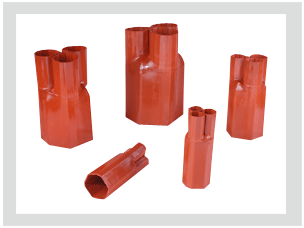
Non-tracking, GAB
Is the cable above 3.3 kV? Insulcore-NT seals the crutch of 3-core PVC and PILC cable up to 36 kV, in non-tracking cross-linked polyolefin lined with water-resistant mastic. Nine sizes, GAB-0820 to GAB-3060, all 3-core.
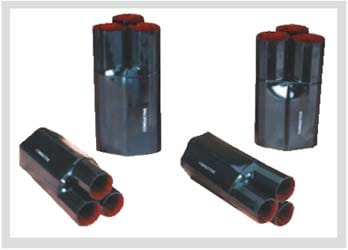
Semi-conductive, GCB
Is the cable belted PILC? Belted paper cable carries no screen on the individual cores. This family seals the crutch and reconstructs that screen at the same time, in red-mastic-lined semi-conductive material. Four sizes, GCB-0820 to GCB-2755.
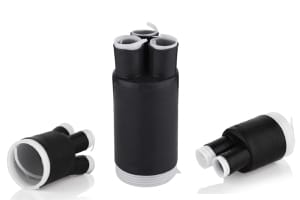
Cold shrink, GCEB
Is a flame allowed? Factory-expanded EPDM rubber on a removable core: pull the core and the sleeve closes, with no torch and no tools. Four sizes across 2-core and 4-core, application ranges ⌀17–30 mm to ⌀32–50 mm.
When a moulded breakout cannot be slid on
A moulded breakout has to pass over the end of the cable. At a joint, or on a run already made off at both ends, it cannot.
The branch-off clip goes there instead. GBOC is a small moulded clip that sits in the fork and holds two cores apart while an outer sleeve recovers over them.
The clip and the sleeve are one system. Its outer surface carries a hot melt adhesive layer that melts as that sleeve shrinks. Alone, the clip seals nothing, and the sleeve alone would pull into the fork rather than close over it.
Three sizes, published for telecom cable jointing. On the manufacturer's photograph of a finished branch, the adhesive shows as an amber bead pushed out of the fork beside the clip.
Branch off clip, GBOC selection chart
| Gala code | H | J | M | P | R | S | T | U | K |
|---|---|---|---|---|---|---|---|---|---|
| GBOC 1 | 2.5 | 5 | 12 | 64 | 28 | 55 | 13 | 4.5 | 28 |
| GBOC 2 | 3.0 | 6 | 12 | 110 | 60 | 85 | 15.5 | 18.5 | 54 |
| GBOC 3 | 3.0 | 6 | 13 | 125 | 85 | 103 | 17 | 30 | 79 |
All dimensions in mm, tolerance ±5%, from the manufacturer's Branch Off Clip sheet, Issue 1, February 2026.
What the clip sheet does not publish
The nine letters are called out against a line drawing, and no legend on the sheet names them. No cable or core diameter range is given for any of the three sizes either. A GBOC therefore cannot be selected from published data alone: the size has to be confirmed with the manufacturer against the two core diameters it must hold apart.
Branch off clip, published properties
| Property | Value | Method |
|---|---|---|
| Tensile strength | 2 N/mm² (MPa) min. | ASTM D638 |
| Ultimate elongation | 700% min. | ASTM D638 |
| Density | 0.9 g/cm³ max. | ASTM D792 |
| Hardness | 75 ± 5 Shore A | ASTM D2240 |
| Dielectric strength | 12 kV/mm min. | ASTM D149 |
| Volume resistivity | 1 × 10¹⁴ ohm min. | ASTM D257 |
| Dielectric constant | 5 max. | ASTM D150 |
The sheet prints the resistivity unit as ohm rather than ohm.cm. Hardness is quoted on the Shore A scale here and on Shore D for the breakout bodies, so the two figures are not comparable.
The words and the letters
- Crutch
- The point where a multi-core cable's cores separate from the common sheath. Everything on this page happens there. The rest of the vocabulary is glossed at boot, breakout, shroud, sleeve.
- Free recovery
- What the part shrinks to with nothing inside it. Every f figure in every chart is a free-recovery figure, so on a real cable the part stops short of it and grips.
- Range-taking
- The band between the as-supplied and the recovered diameter, and the reason one code covers several cable sizes. On LV3GBB-1330 that band runs 80 mm down to 30 mm.
- Ds and Df
- Internal diameter of the body. Ds is as supplied and is a minimum; Df is after free recovery and is a maximum.
- ds and df
- Internal diameter at each leg, on the same convention. Four codes carry two different leg diameters instead of one, printed as d1 and d2 on a separate chart.
- Ls, Lf, ls, lf
- Body length and leg length. These four are best read as nominal. The Lf and lf columns are qualified as minimums on one published issue and as maximums on another. The diameter columns agree across all of them.
- Tb and Tc
- Wall thickness of the body and of the legs, both to ±10%.
- The asterisk
- Marks a new size on the chart, not a superseded one.
Next
- Breakout size chartAll 69 Insulcore-LV rows, with the GAB, GCB and GCEB charts beside them.
- Breakout or boot?One goes where cores separate. The other goes where a cable meets something.
- Installing a boot or a breakoutWhere the heat starts, and what shows that the adhesive has run.
- Replacing a boot when the part number is goneA method for an unmarked part off a decommissioned panel.
- Heat shrink bootsThe other hub on this site: connector, bushing and busbar transitions.
Ask about a size
A useful enquiry carries five things: the cable's outside diameter at the crutch, one core's outside diameter just past it, the core count, the insulation type and the voltage class. Those five pick a code straight off these charts.