Four codes · GCEB · no flame
Cold shrink breakouts
Two cores or four. The smallest goes on at 47mm as supplied and closes onto a crutch of Ø17–30mm.
Pull the core, and that is the installation
The part arrives already stretched and held open on a removable spiral. You place it over the crutch, unwind that spiral out through the mouth of the body, and the rubber closes onto the sheath and onto each core as its support comes away. The manufacturer's drawing labels the spiral a PP coil.
No torch, no gas bottle, no gun, and no second attempt. Once the coil is out the rubber has recovered, and nothing on site will expand it again.
A heat shrink breakout seals because an adhesive or mastic lining melts and flows into the fork. This one carries neither: the datasheet's feature list says no mastic or tape is required, which puts the entire seal on the contact pressure of stretched rubber against whatever it landed on.
One mouth, two or four fingers, and cores separating underneath. Where a cable is meeting a connector or a bushing rather than splitting, the part is a boot and the choice is made before the size is.
GCEB cold shrink breakout
A black rubber crutch seal, factory expanded onto a removable core, for the branch-out point of 2-core and 4-core cable. Four catalogued sizes covering cable diameters from Ø17mm to Ø50mm, fitted without heat. Manufactured by Gala Thermo Shrink Pvt. Ltd.
- Installs by unwinding the core: no torch, no flame and no tools
- No mastic and no tape, so nothing has to be heated through to make the seal
- Tough rubber formulation withstands backfilling
- Resists abrasion, ozone, fungus, acids and alkalis
- Published as having excellent wet electrical properties and as retaining its resiliency for years
- Free of chloride and sulfur, which is the material claim the sheet makes about it twice
| Codes | GCEB2-1, GCEB2-2, GCEB4-1, GCEB4-2 |
|---|---|
| Core counts catalogued | 2 and 4 only |
| Body as supplied, Ds (min.) | 47mm to 70mm |
| Cable application range | Ø17–30mm up to Ø32–50mm |
| Finger as supplied, ds (min.) | 20mm or 25mm |
| Core application range | Ø10–14mm or Ø12–17mm |
| Body length recovered, Lf (max.) | 50mm or 65mm |
| Finger length recovered, lf (max.) | 30mm |
| Material | EPDM rubber, free of chloride and sulfur |
| Colour | Black |
| Dielectric strength | 14.3 kV/mm |
| Ultimate tensile | 9.6 MPa |
| Ultimate elongation | 750% |
| Water seal | Meets the requirements of ANSI C119.1 |
| Operating temperature | −40 °C to 105 °C on the datasheet; a second published source says 90 °C |
GCEB selection chart
| Code No. | Cores | Ds (min.) | Cable application range | ds (min.) | Core application range | Lf (max.) | lf (max.) |
|---|---|---|---|---|---|---|---|
| GCEB2 - 1 | 2 | 47 | Ø17 - Ø30 | 20 | Ø10 - Ø14 | 50 | 30 |
| GCEB2 - 2 | 2 | 65 | Ø23 - Ø45 | 25 | Ø12 - Ø17 | 65 | 30 |
| GCEB4 - 1 | 4 | 60 | Ø24 - Ø40 | 20 | Ø10 - Ø14 | 50 | 30 |
| GCEB4 - 2 | 4 | 70 | Ø32 - Ø50 | 25 | Ø12 - Ø17 | 65 | 30 |
All dimensions in mm, from the manufacturer's Cold Shrink Breakout sheet, Issue 1, March 2025. Its legend reads: D is the body diameter, d the finger diameter, s as supplied, f after free recovery. Note the word the sheet uses for a leg here is finger.
Mechanical properties
| Property | Test method | Typical value |
|---|---|---|
| 300% modulus | ASTM D-412 | 3.3 MPa |
| Ultimate tensile | ASTM D-412 | 9.6 MPa |
| Ultimate elongation | ASTM D-412 | 750% |
| Die C tear | ASTM D-624C | 26.3 kN/m |
Values as published in the sheet's Technical Specification table, which prints the tear unit as KN/m.
Environmental and electrical properties
| Property | Test method | Typical value |
|---|---|---|
| Colour | Visual | Black |
| Fungus resistance | ASTM G-21 | 28 days exposure, no growth |
| Moisture absorption, 7 days at 90 °C H₂O | Internal method | Weight gain 1.8% |
| Dielectric strength | ASTM D149 | 14.3 kV/mm |
Moisture absorption is the one line here measured by an internal method rather than a published one. The 90 °C in that row is a soak condition for the test, not a service rating.
What the selection chart does not publish
Three gaps, and the first one changes how you size. There is no Df or df column. The recovered diameter of the body and of the fingers is not given, so the application range is the only band you can select against — unlike every heat shrink chart on this site, where an as-supplied minimum and a recovered maximum sit side by side. There is no as-supplied length either: Lf and lf are both quoted after free recovery, and nothing is published for the part still on its coil. And no rated voltage appears on the sheet at all. 14.3 kV/mm is a material dielectric strength measured to ASTM D149, not a cable class; the heat shrink breakout a GCEB would displace is published to 3.3 kV. Confirm the class with the manufacturer before a cold shrink part goes on a circuit whose voltage has to be stated on a drawing.
What is printed on the part is not the chart code
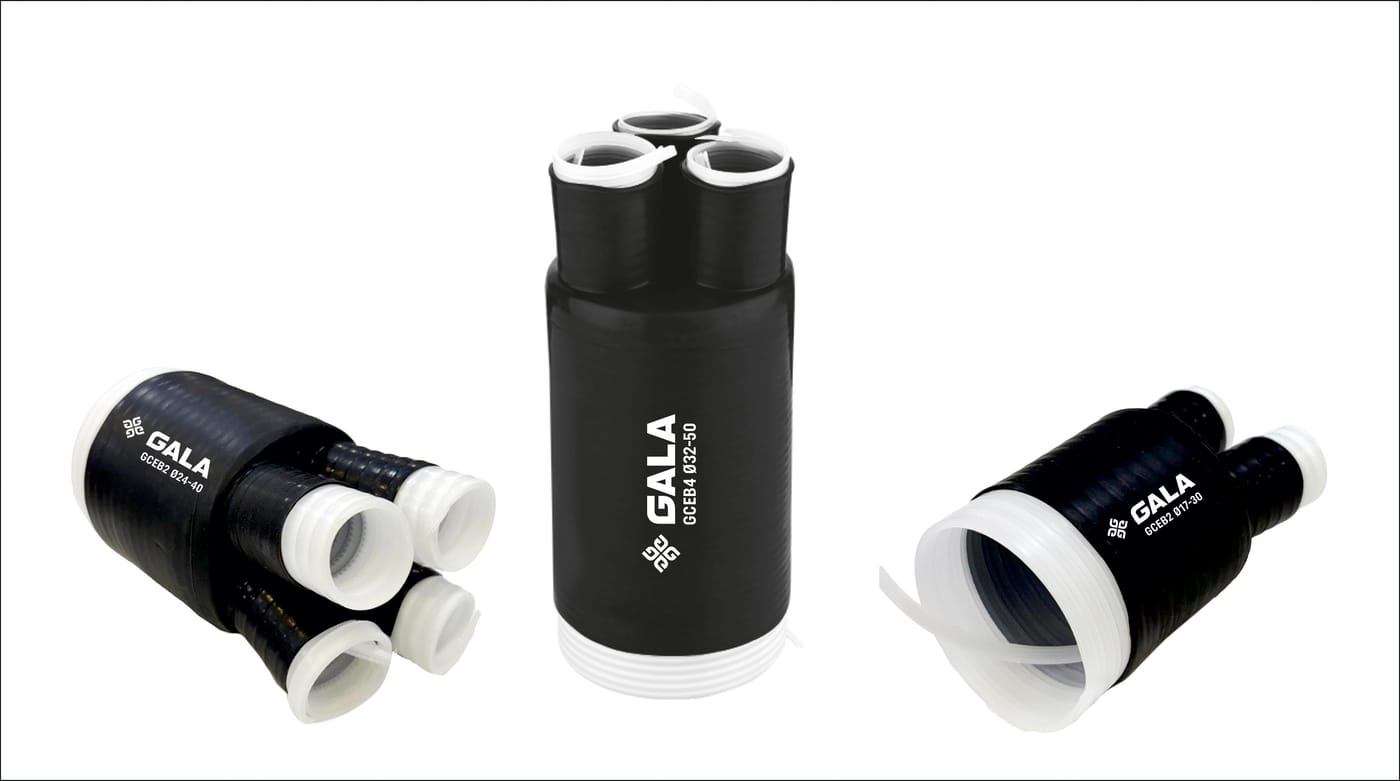
The manufacturer's photograph shows three parts, and each is printed with a core count and a diameter band rather than with the -1 or -2 suffix the chart uses. GCEB2 Ø17-30 is the chart's GCEB2-1. GCEB4 Ø32-50 is GCEB4-2.
The third is printed GCEB2 Ø24-40 and four fingers are visible on it. Ø24–40 is the band the chart gives for GCEB4-1, a four-core code. The two readings do not agree, and this site cannot tell you which of them is the error.
So count the fingers on the part in your hand before you read the digit in front of the diameter. That is the same order of operations as working out a part with no number left on it.
Where the published sources disagree
Two conflicts on these same four codes, printed rather than reconciled. Operating temperature. The manufacturer's Cold Shrink Breakout page and the Issue 1 datasheet behind it both give −40 °C to 105 °C. Its Cold Shrink Breakouts page — same paragraph, same chart, same four codes — gives −40 °C to 90 °C. Material. Both of those web pages describe high quality EPDM Rubber; the datasheet describes high quality Silicon / Rubber in the same sentence position. Neither discrepancy has been put to the manufacturer, and nothing on this page resolves either. If a specification is being written to 105 °C, or to EPDM by name, get that confirmed in writing before it is issued.
Where cold shrink earns its place, and where it stops
Two conditions make this the part. A hot work permit that is not going to be granted, or plant live and close enough that no one is lighting a flame regardless; and a pit, trench or duct mouth where a torch and a cylinder will not physically fit anyway. Every other crutch part in this range needs heat.
The boundary is the catalogue, and it is narrow. Four codes across two core counts, against sixty-nine heat shrink sizes spanning 2, 3, 4, 5, 6 and 7-core cable. A three-core crutch has no cold shrink code at all.
The largest body takes Ø32–50mm, so above Ø50mm the decision is made for you and the heat shrink families carry it to Ø370mm. Below Ø17mm there is nothing here either.
The mechanism argument behind all of that — stored elastic energy against a crosslinked memory, and what each costs on site — is set out at heat shrink versus cold shrink, a reference this same publisher runs from the same manufacturer's sheets. It is not repeated here.
Fit is settled on this page. The risk moves to the procedure next, and that is where the coil comes out and in what order.
Ask about a GCEB size
Four figures pick a code straight off the chart above: the cable's outside diameter at the crutch, one core's outside diameter just past it, the core count, and whether a flame is permitted at that location. Say which of the two published temperature ranges your specification has to meet, and the reply can be written against that figure rather than around it.